FREE SHIPPING on most orders over $50!
New Arrivals
Events
248.673.1900
info@motorcityguitar.com
0
Home
Shop By Category
Electric Guitars
Solid Body
Semi-Hollow
Hollow Body
Left-Handed Electrics
Travel & Mini Electrics
12-String
Baritone
Other Electric Guitars
Electric Guitar Packages
Acoustic Guitars
Acoustic Steel String
Acoustic-Electric Steel String
Classical Nylon String
12-String
Left-Handed Acoustics
Travel and Mini Acoustic
Acoustic Guitar Packages
Bass Guitars
4-String
5-String
6-String
Fretless
Acoustic Basses
Short Scale Basses
Left-Handed Basses
Bass Guitar Packages
Upright Basses
6 & 7-String Basses
Effects and Pedals
Effects Pedals
Multi-Effect
Rackmount Effects
Pedal Boards
Pedal Board Accessories
Weird Noisemakers
Amps
Guitar Amps
Bass Amps
Keyboard Amps
Attenuators and Cab Simulators
Parts
Pickups
Guitar Parts
Guitar Necks
Guitar Bodies
Replacement Speakers
Tubes
Amp Parts and Accessories
Folk Instruments
Ukuleles
Banjos
Mandolins
Harmonicas
Drums
Cymbals
Drum Accessories
Electronic Drums
Pro Audio
Mixers
PA Speakers
Recording Gear
Microphones
Microphone Accessories
Wireless Systems
PA System Packages
Signal Processors
PA Power Amps
Cables, Snakes and DI Boxes
Keyboards and Synths
Keyboards
Synths
Beat Production
Keyboard Accessories
Accessories
Cables
Straps
T-Shirts, Hats and Swag
Gifts and Collectibles
Picks
Cases and Gig Bags
Stands
Strings
Tools and Cleaning Supplies
Tuners
Capos
Headphones
Power Supplies and Batteries
Slides
Rackmount and Utility Cases
Amp Covers and Cases
Metronomes
Practice and Performance Aids
Humidifiers
0
Shopping Cart
Your cart is currently empty.
Continue Shopping
My Account
Welcome to Motor City Guitar!
Login
Create Account
Home
Effects Pedals
Fish Circuits Astronomie Digital Spring Reverb Pedal
New
Previous Product
|
Next Product
Default Title - $349.00 USD
$349.00
Maximum quantity available reached.
Sku:
FISHASTRONOMIE
Brand:
Fish Circuits
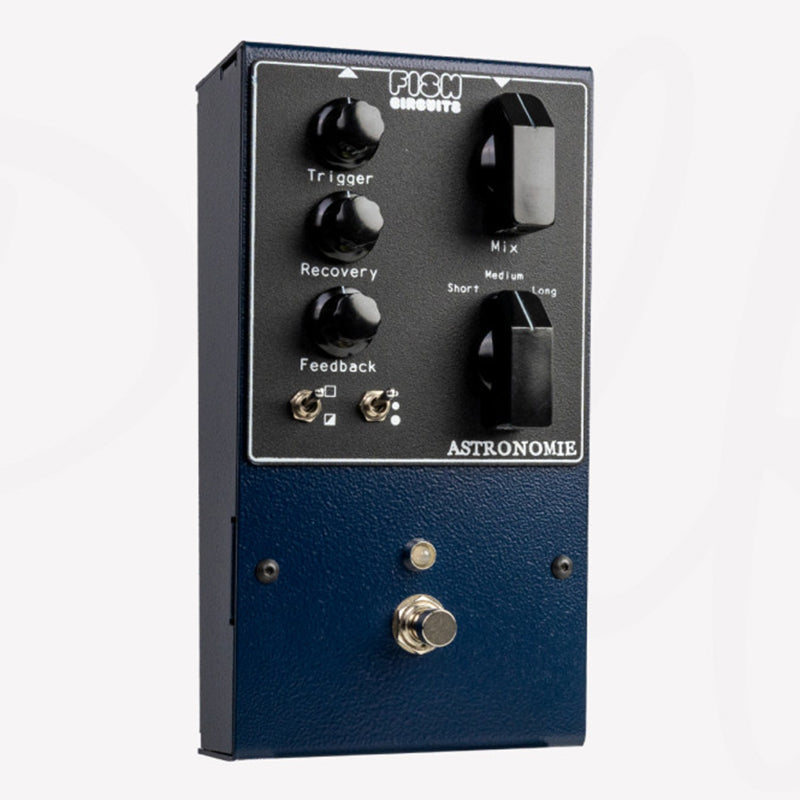
Fish Circuits Astronomie Reverb Pedal
The Fish Circuits ASTRONOMIE is a digital spring reverb with 3 decay settings, 3 tone presets, and an adjustable feedback. That's pretty common. What's not as common is the pedal’s ability to dynamically lower the effect’s volume with each note picked. Imagine having a reverb that swells in automatically as you let your chords ring, or playing a tight rhythmic riff which is not muddied while being able to have a long reverb trail once you stop playing. We’re not smart enough to think of every possible way to use this effect, but it’s easy to see how vast the possibilities are once the ASTRONOMIE falls into the hands of a creative mind.
Controls
“Trigger” adjusts sensitivity, arguably the most important control on this pedal. It allows not only to adjust how easily the effect’s volume will dip, but also how deep. Turning it completely counterclockwise will basically deactivate that part of the circuit. And as it is turned clockwise, the reverb’s volume will gradually duck more with each pick stroke until just about anything will trigger a volume dip at the clockwisest setting. Different guitars and pickups will hit the pedal differently. And a compressed, distorted, or overdriven signal will not be as dynamic, of course, so any change upstream could mean a need to readjust Trigger. Trigger also works hand in hand with the Recovery control, and the key to understanding these two is to know that they affect one another. For example, a faster Recovery means that you will need a more aggressive Trigger to achieve the same depth in volume dip, and vice versa. Turning one of these knobs often means readjusting the other.
“Recovery” adjusts how fast the reverb fades back in. This can go from 1-2 seconds when counterclockwise to pretty much instantaneous when it is fully clockwise, and everything in between. As mentioned earlier, it is deeply affected by the Trigger control. You could view the Trigger control as what you will feel in your hands and the Recovery control as what you will feel in your ears. Also, just for fun, when at its clockwisest position, it’ll sound glitchy. Whether that’s what you want or not, player’s discretion is advised.
“Feedback” dials in how much of the reverb should feed into itself. The signal being fed back is filtered, meaning that it doesn’t have as much low end anymore which keeps everything tighter and manageable. However with Feedback at max and decay set to Long, the results might become disorderly, so to speak. Again, you’ve been warned.
Left Toggle. They thought they were so clever not labeling their toggles. Anyway, the Left Toggle allows to set a minimum reverb amount. That minimum is set by the manufacturer, thank you very much, and is what felt right to them. The top position is the full volume dip, and the bottom position is the Fish Circuits approved minimum.
Right toggle. The right toggle (with the circles) controls the tone of the reverb. The bottom position is full range, middle is a bit tighter and leaves more room for the clean signal, and the top position has even less low end which can feel ethereal, airy, celestial, or any other synonym in that lexicon.
“Mix” controls how much reverb and/or clean sound is present. Counterclockwise means less reverb, clockwise means more. At zero, there is no reverb at all in case you want to use this pedal as a buffer, which is not recommended but possible. On the opposite end there will be no clean signal at all, which can be fun, but expect a slight delay.
Short, Medium, Long. Short decay, Medium decay, and Long decay. This controls the length of the reverb effect before it naturally fades out. It is affected by how much Feedback is present and by the right toggle’s tone setting, but each position on this rotary switch has a different character such that everything else will probably need to be tweaked when going from one setting to another.
Features:
• Dimensions: 4” x 7.75” x 2.75”
• Weight: 2.4lbs
• Power: 9V DC, negative tip, 2.1mm barrel power supply
• Current draw: 100mA