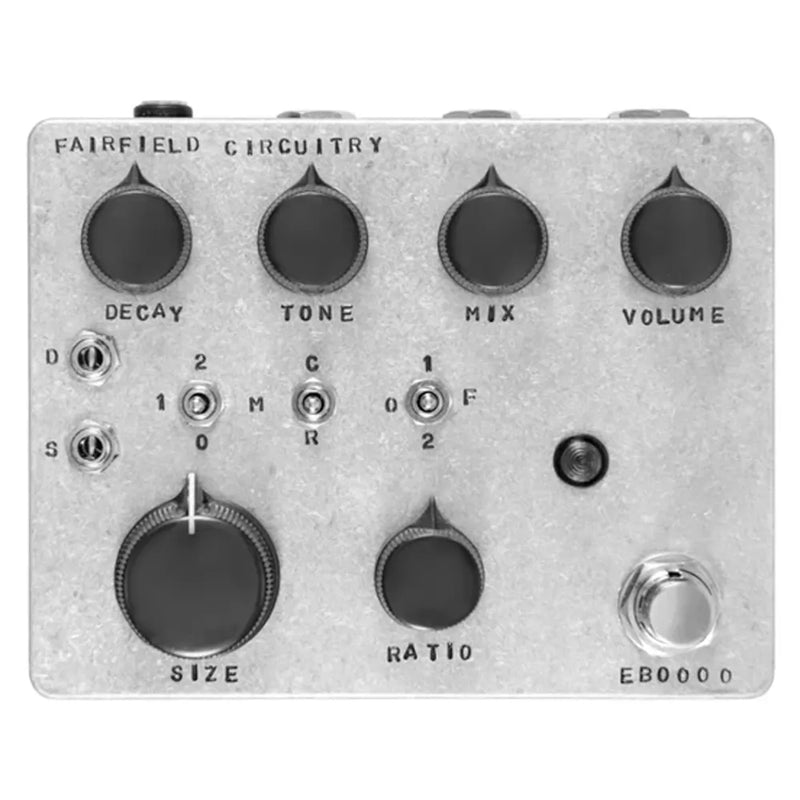
Fairfield Circuitry Placeholder Bucket Brigade Analog Reverb Pedal
New

$489.00
Maximum quantity available reached.

Sku: FAIRFIELDPLACEH

I am sitting in a room
Distance between things

Blinded by the moment
Subdued by its effect

In phase and out of it
Space is the place


Placeholder is an analogue implementation of a digital reverb algorithm using BBDs, mixers, VCAs and simple zesty filters. The topology in question is called Householder, allowing quick echo density even with only three delay-lines.

There's no denying the power of algorithmic representation of daily activities. But let's not forget that the complex-system underlying the lived experience, the background noise and uncertainty, is intrinsic.


Three independent analogue delay-lines act as foundation to this particular type of feedback-delay- network.

A householder-reflection feedback matrix (figure 1) creates context for quick echo density; every delay line feeds back only to every other delay line.

The excitation is looking for the longest way out. Surprisingly, this analogue implementation of a basic digital reverb algorithm sounds quite unique.

Creating space that is both familiar and unusual.


Truly unique approach; analogue emulation of a digital reverb algorithm using bucket brigade devices. The signal path is all-analogue.

Controls altogether allow for a surprising array of possibilities:

• large bingo halls
• bathrooms and shower stalls
• spring-like flavours
• semblance of plate reverbs
• unrealistically small rooms
• real close to flanging


The fully variable controls offer direct control of the room, no presets. Emphasizing the analogue nature of the circuit. Making the night more interesting.

There’s a real adventure in tuning SIZE and RATIO, an adventure through nodes of flutter and diffusion.

Digital control allows all three delays to have their own unique, random and cyclical modulations rendering rooms that move ever so slightly while also improving smear.


INTERPRETATION

There are three parallel delay-lines each with their own nested feedback paths. These paths are out of phase.

There is a fourth feedback path consisting of the sum of the three delay-line outputs with the resulting tilt filter output. This path is in phase.

All four feedback paths have a VCA to control their gain. They all share the same control voltage, DECAY. This means each delay-line’s nested feedback gets cancelled. The resulting feedback consists only of the other two delay-lines.