FREE SHIPPING on most orders over $50!
Continue Shopping
Welcome to Motor City Guitar!
Legendary Tones 1987 Caswell Mod Standard Edition - Standard Wire
Caswell 1987 Mod – Bringing Back the Spirit of S.I.R. #39
In 1987, the sound of rock changed forever. It was raw, unapologetic, and drenched in attitude. Tim Caswell’s infamous #39 mod turned a standard Marshall into a snarling, harmonically rich beast, and with it provided a tone that fueled a generation of guitar heroes and defined an era when rock truly ruled the airwaves.
Now that legacy returns.
The Caswell 1987 Mod captures the heart and soul of that groundbreaking circuit with the aggressive gain structure, sensitivity, and harmonic fire that made #39 a legend. Built on the foundation of our acclaimed Hot Mod V2, the Caswell 1987 Mod refines the formula for today’s player while staying true to the original spirit of late-’80s excess and sonic dominance.
Expect explosive punch, glassy upper harmonics, and that unmistakable “LA Strip” grind that jumps out of the mix. Whether you’re chasing the tone of your idols or forging your own signature voice, the Caswell 1987 Mod delivers the elusive mix of clarity and chaos. It’s the sound of 1987, reborn.
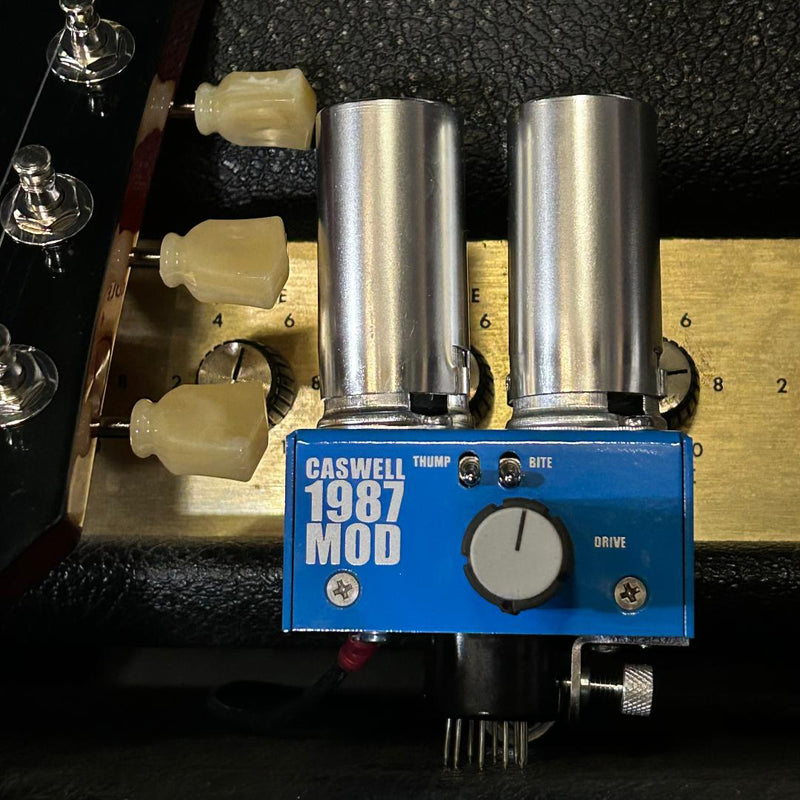
Thump Switch
Engage the Thump switch and unleash a massive low-end response that hits like a freight train. It adds deep, percussive punch and body to your tone, giving palm-muted riffs and power chords that unmistakable ’80s arena impact.
Bite Switch
Flip the Bite switch to ignite upper-midrange harmonics and enhance note definition and presence. This feature adds edge and articulation, letting solos cut through with searing clarity and that classic LA studio sizzle.
Drive Control
The Drive pot gives you total command of the added gain stage. From tight, classic crunch to full-blown, saturated lead tones, the Drive control lets you dial in your perfect level of aggression and sustain.
Pure attitude, no compromises. The standard Caswell 1987 Mod brings the raw, high-voltage aggression and spirit of the legendary #39 circuit straight to your amp. Built with premium components and tuned for punch, clarity, and harmonic richness: this is the sound of 1987 reborn and ready to roar
***There are two different models currently available. This listing is for the Caswell Mod Standard Wired:
For original JMP and JCM 800 series 2203/2204/1959/1987. The standard wired model also works for the early reissue 1959/1987 models without the factory-installed effects loop. Choose the standard wire option if you use the new Marshall studio series SC20H/SV20H heads as well!
Will my Caswell Mod work in my amp?
HOT MOD V2/LYNCH/CASWELL MOD STANDARD WIRED COMPATIBILITY LIST:
Marshall (vintage, JMP):1986, 1987, 1987T, 1959, 1959HW (reissue), 1962,1968, 1992, 2203*, 2204*, 2104, 2103, 1989, 2245 (JTM 45)Marshall JCM 800:2000 (V3 position), 1987, 1959, 2103, 2203, 2203KK, 2104, 2204, 2205 (1981-1983 models only), 2210 (1981-1983 models only), 4010, 4103, 4104, 4210 (1981-1983 only), 4211(1981-1983 only), 4212 (1981-1983 only)Marshall JCM 900:2500, 2501, 2502, 2100, 2101Marshall Vintage Reissue:1987x (pre-2003 without Marshall factory effects loop), 1959 (without factory effects loop), 2245THW (handwired JTM 45 reissue), 1959 YJMMarshall Studio:This new series of mini 20 watt heads require the removal of the L bracket and thumbscrew so that the units can fit into the PCB-mounted socket in the amp which does not use a base tube shield.SC20H/SV20H (Heads only)Friedman Amps:BE-100, BE-100 DLX, BE-50 DLX, Small Box, PT-20**, Twin Sister, Plex**NOTE 2: While the Friedman PT-20 is sonically compatible with the HMV2E, Lynch Mod, and Caswell Mod, the head enclosures are too shallow and don’t have enough depth to fit the HMV2E chassis without FIRST removing the amp chassis from the head box. So if you would like to use the Mod with these amps, you first need to remove the chassis bolts, slide out the chassis, install the mod, and then slide the chassis back into its head box and retighten the chassis bolts.Orange Amps:OR50Peavey Amps:VTM-60, VTM-120 and Butcher (original 1980s version)Sovtek Amps:Mig 60, Mig 100Jet City Amps:JCA5212 standard wire V4 positionNOTES ON OTHER AMPSClones:The Hot Mod V2 has been found to work well in a variety of Marshall 1959/1987/2203/2204 clone and similar circuits including: Ceriatone, Germino, Mojotone, Wangs, and Bugera (Bugera needs reverse wired model and is compatible with pre-Infinium 1960 model only. Bugera Infinium 1960 does NOT work). Other Amps:The Mods are designed to work with amps which use a cathode follower design into the tone stack. It adds a gain stage essentially on top of the cathode follower. As a result, the HMV2 will function in other classic amps like Fender Pro, Super, Twin, etc. as well as others like Vox AC30 or certain Traynor amps, etc. However, the circuit of the HMV2 has been tuned and optimized for Marshall circuits, so LegendaryTones generally recommend they be used for the models in the list above only. If they were to make a design for a Fender for example, it would be tuned differently just like it would also be tuned differently for a Vox.Popular amps that the Mods DO NOT WORK with include: Marshall Silver Jubilee series, Marshall Origin series, Marshall Vintage Modern Series, Mesa Boogie Mark series amps, Bugera 1960, and Hiwatt DR series. Some HistoryBack in the late 1980s, Mike Soldano of Soldano Custom Amplification released his original Hot Mod, a design based around use of rare 6C10 (and then later 6K11) tubes. These tube types added more gain much the same way that the Legendary Tones Mods do, but they had limitations. The tubes were long out of production, getting expensive to find, and often would become microphonic and therefore limited in capability. The original Soldano Hot Mod had lots of gain and delivered on its promise, but it was ultimately taken out of production primarily due to the challenges with finding consistent and quiet tubes.Still, the original Hot Mod was the inspiration for the Legendary Tones Mods, which function in much the same way as the original, but now have additional circuitry that further stabilize the design, provide more clarity, and deliver a wider, more controllable range of gain on the preamp control of the amp rather than coming onto high-gain territory too quickly. And of course the HMV2ELynch, Mod and Caswell 87 now also uses a 12AX7 and 12AT7 tubes that are commonly available.